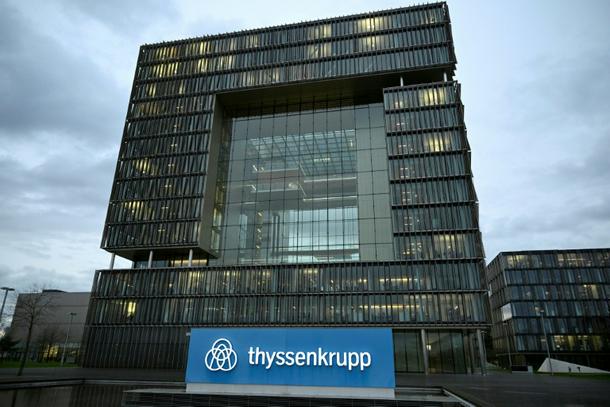
The Iran war 'has triggered a substantial energy price shock and clouded economic prospects worldwide', Thyssenkrupp says
Frankfurt (Germany) (AFP) - German industrial giant Thyssenkrupp cut it sales forecast Tuesday, warning that the war in the Middle East would weigh on customer demand.
Revenue is now expected to be flat or fall by up to three percent for the year, the company said, down from a previous forecast range of a two-percent fall to one-percent growth.
“The anticipated recovery of the global economy has been dampened significantly,” Thyssenkrupp said in its second-quarter report.
“As well as the war in Ukraine, the main factors are the escalation of the Iran conflict which has triggered a substantial energy price shock and clouded economic prospects worldwide.”
For the second quarter it posted a loss of 11 million euros ($12.9 million) compared with a profit of 167 million euros in the period a year earlier, hit by restructuring costs.
Without them, the company said its core profit rose to 198 million euros from 19 million last year, boosted by cost cuts.
Industrial firms such as Thyssenkrupp – a vast conglomerate with interests in steel, machinery and car parts – are often seen as bellwethers for the global economy as their fortunes rise and fall with worldwide business activity.
Thyssenkrupp said it still expected a full-year net loss of 400 million to 800 million euros, with the figure rising to a profit of 500-900 million euros once certain expenses like tax and one-off restructuring costs are stripped out.
Hammered by surging energy costs and cheaper Asian competition, Thyssenkrupp’s steel unit said in November 2024 that it would seek to cut or outsource 11,000 jobs by 2030, representing around 40 percent of its workforce.
The conglomerate was in discussions with India’s Jindal Steel about a potential sale of the unit, but the talks were paused this month after the European Union said in April it would hike steel tariffs, helping protect steelmakers but raising prices for consumers.
Chief executive Miguel Lopez told reporters on a conference call that he was seeing “first signs” that European steel prices were recovering.
“In terms of prices, of course not in the next quarters, we won’t see that, not in the next two, but the ones after we will see an effect on prices,” he said.