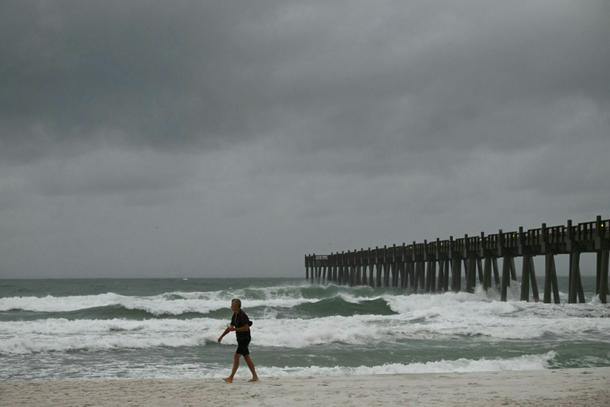
A person watches as waves build near the Pensacola Beach Gulf Pier in Pensacola Beach, Florida ahead of the arrival of Hurricane Isaias
Pensacola (United States) (AFP) - Hurricane Isaias’s outer bands began lashing the US Gulf Coast on Friday, with the category 3 storm triggering mandatory evacuations and poised to bring life-threatening storm surge when it makes landfall by evening.
Isaias is the first hurricane of an Atlantic season held in check by a historic El Nino phenomenon, and is set to become the first hurricane to strike the US mainland since Milton in 2024.
Fueled by record-warm Gulf waters heated by climate change, it strengthened rapidly over the past day.
“Isaias is coming in right over us,” Jane Drescoll, a 63-year-old resident of Pensacola, told AFP, holding on to her hat as she spoke on the beach.
She said she had stocked up on propane and water and had been through eight hurricanes since moving to the area a decade ago.
The storm’s intensity could fluctuate, but forecasters expect it to slam into the western Florida panhandle at or near major hurricane strength – meaning category 3 – before weakening over land. Tropical storm conditions began along the northern gulf coast as of Friday afternoon.
The National Hurricane Center (NHC) said Isaias was packing maximum sustained winds of 120 miles (195 kilometers) per hour, and was located about 145 miles south of Pensacola.
President Donald Trump said he had canceled his visit to Saturday’s college football game between the University of Georgia and the University of Alabama in Tuscaloosa, Alabama because of Hurricane Isaias.
“It is important to have our wonderful First Responders, Law Enforcement, and others, focused on that Storm, and in no way be thinking about the safety, or presence, of the President of the United States, ME!” he wrote on Truth Social.
There are “higher and higher probabilities that it’s going to make landfall tonight around 11:00 pm” somewhere in Santa Rosa or Okaloosa counties, Florida Governor Ron DeSantis told a press briefing.
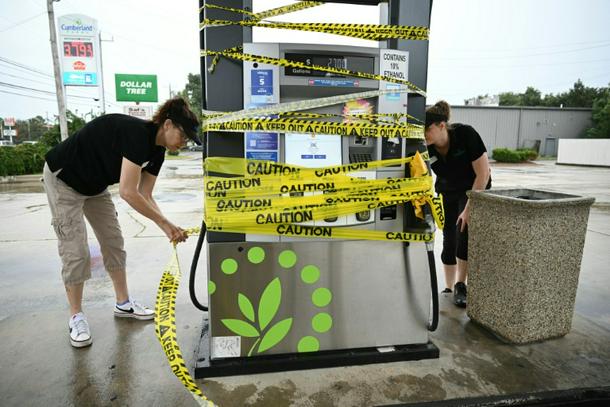
Workers cordon off a gas pump with yellow tape at a gas station in Navarre, Florida as Hurricane Isaias approaches
Mandatory evacuation orders are in effect in several Florida counties, but the impacts are expected to spread over a swathe of the southeastern United States, with hurricane-force winds up to 100 miles inland.
Those staying put are advised to hunker down in safe rooms and prepare for long power outages.
Storm surge combined with the tide is expected to flood normally dry areas, with the NHC warning that water could reach as high as nine feet (2.7 meters) around the Alabama-Florida border. Heavy rainfall could trigger flash flooding and rivers could also break their banks.
At least two airports in northwestern Florida have suspended operations.
- Late arrival -
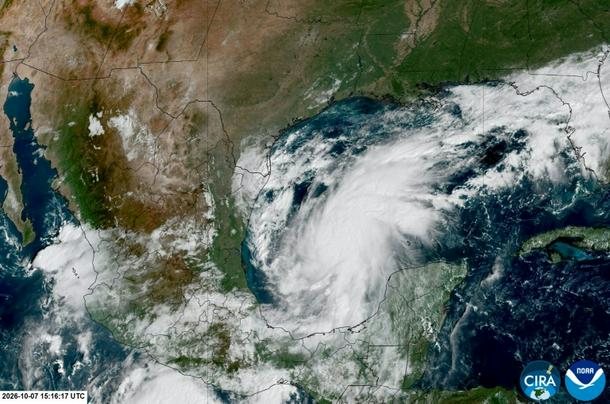
This satellite handout image from the Cooperative Institute for Research in the Atmosphere at Colorado State University and the National Oceanic and Atmospheric Administration (CIRA/CSU and NOAA) shows Isaias developing in the Gulf of Mexico
Isaias’s late arrival is largely due to an El Nino of historic strength.
El Nino, the warm phase of the El Nino-Southern Oscillation (ENSO), creates strong vertical wind shear over the Atlantic that tends to tear storms apart.
“We have been seeing basically nearly record strong shear throughout the Atlantic Basin this year, and that is consistent with what we’d expect to see with a strong El Nino event,” Michael Fischer, of University of Miami’s Rosenstiel School of Marine, Atmospheric, and Earth Science, told AFP.
In the Pacific, it has the opposite effect, weakening shear and giving storms room to grow. The Pacific has already produced several hurricanes this year, some of which hit maximum category 5 strength.
Meanwhile, sea surface temperatures across the Gulf are running at nearly 30C, said Fischer, “basically as warm as any year we’ve seen over the last 40 years or so.”
“Sea surface temperatures in the Gulf of Mexico are in record territory because of fossil fuel-driven climate change,” Marc Alessi, a climate scientist with the Union of Concern Scientists, told AFP. “Isaias was able to tap into all of that energy in the ocean to develop into a major hurricane.”
Isaias has disrupted oil and gas production in the Gulf of Mexico, with platforms and rigs evacuated.
As of Friday, about 71 percent of the region’s oil production had been temporarily halted, taking nearly 1.5 million barrels a day off the market, according to the Marine Minerals Administration (MMA). About 59 percent of gas production was also suspended.