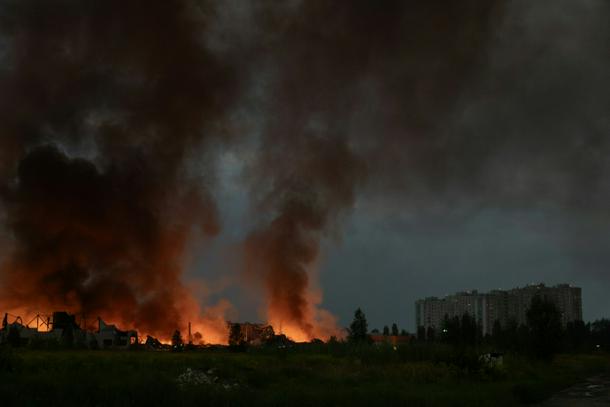
A Russian ballistic missile strike destroyed a warehouse on the outskirts of Kyiv Wednesday
Kyiv (Ukraine) (AFP) - United Nations chief Antonio Guterres on Thursday condemned both sides for attacks on civilian areas as Ukraine and Russia kept up their artillery war.
Ukraine struck two Russian oil refineries hundreds of kilometres from the border in an overnight attack, President Volodymyr Zelensky said Thursday, as Russia hit a train station and commercial ship in Ukraine.
Both sides have been intensifying their long-range attacks in recent months, leading to a jump in civilian deaths.
Kyiv has been firing record numbers of drones at Russia, while Moscow has been launching all-time high missile attacks.
Zelensky said Ukraine had hit oil refineries in the Bashkortostan and Yaroslavl regions – about 1,300 (800 miles) and 700 kilometres from the front.
Russian missile attacks on Kyiv a day earlier had killed at least 17 and destroyed warehouses belonging to a number of retailers in what was widely seen as a direct response to Ukraine’s campaign targeting Wildberries, widely dubbed “Russia’s Amazon”.
But Guterres called Thursday for an end to the deadly attacks on civilian areas in both countries.
“These latest series of attacks follow an alarming pattern of escalating strikes against populated areas,” spokesman Farhan Haq told reporters.
“Attacks against civilians and civilian infrastructure are a clear violation of international humanitarian law, and must stop immediately,” he added.
- Strikes on both sides -
Earlier Thursday Zelensky said of Ukraine’s latest attacks that they were “strengthening the prospects for diplomacy”.
Posting a video from Russian social media of black smoke rising above an oil facility, he added: “Russia must choose peace.”
Russia’s defence ministry said earlier it had downed 605 Ukrainian drones in the night.
The governor of the Yaroslavl region – north of Moscow, where Zelensky said a refinery had been hit – said 92 drones had been downed there in what he called the “most massive” attack on the region of the war.
In the Tver region, also north of Moscow, a drone hit a logistics centre belonging to Wildberries – the Russian e-commerce giant heavily targeted over the past month.
Kyiv was unable to down any of the missiles Russia fired, prompting urgent calls from Zelensky for air-defence supplies.
Fresh Russian attacks overnight killed two people at the Lozova train station in the northeastern Kharkiv region.
A commercial vessel carrying Ukrainian wheat was also hit in the Black Sea by Russia, killing one person, the Odesa region governor said.
More than four years after the start of Russia’s large-scale offensive against Ukraine, diplomacy is at a standstill and the two countries are ramping up long-range strikes, causing a growing number of civilian casualties.
- Zelensky to Serbia -
Later Thursday, a senior Ukrainian official told AFP that Zelensky would this weekend make his first visit to Serbia since Russia’s invasion.
The source described Saturday’s visit to Moscow’s traditional ally as a “slap in the face for the Russians”.
Serbian President Aleksandar Vucic’s office confirmed what it described as an “official visit”.
Their statement quoted recent comments by Vucic listing what they needed to discuss, including the two countries’ bids for European Union membership, and economic and energy cooperation.
Serbia is one of the few countries not to have imposed sanctions against Russia.
“Serbia has established its policy,” Vucic said at a public event.
While Zelensky would state his position, Serbia’s policy “will remain the case until further notice”, he added.
- Nuclear power warning -
The UN nuclear watchdog on Thursday warned about a rising number of off-site power losses at the Russian-occupied Zaporizhzhia nuclear power plant in Ukraine.
“This trend, with the rising number of off-site power cuts… is deeply concerning and clearly not sustainable,” Rafael Grossi, head of the International Atomic Energy Agency, said in a statement.
The team at the plant were still reporting “hearing military activity, including explosions, several times a day, often at distances close to the site,” the statement added, repeating a call for “maximum military restraint”.
The plant – which is close to the front line of the war – has repeatedly suffered power cuts, with emergency diesel generators providing power for crucial cooling functions.
Most recently it briefly lost power on Tuesday, with the reason for the cut as yet unclear, it added.
burs-jj/pdw